

I spend a lot of my professional time thinking about the policy and politics around AI. And increasingly, I spend a lot of my time with my friends on the professional campaign left talking about how campaigns should be using AI to win elections. You should check out Kate Gage and the Higher Ground Institute’s AI Campaign Stack site, a great resource on this. And boy I have thoughts on AI in campaigns which I will write up soon.
But first a rant triggered by seeing this tweet from @OrganizerMemes.


When I went on the Harris campaign in 2024 as a staffer to do GOTV for the final few weeks (chronicled previously here in three parts), I got the job because I had history/experience/baggage with campaign field organizing.


I have been involved in Get Out The Vote (GOTV)1 every presidential year, and some midterms, dating back to 2006. Since campaigns are generally a young person’s game, and field especially so, I have a relatively rare long-term insight into what changes and what stays the same when it comes to field organizing in the Democratic Party.
The fundamentals of GOTV do not change as they are dictated by the deadline of the election and the need to take your campaign and focus on turning enough of your voters to hit your win number (and hopefully the win number is calculated correctly to win the election).
But the strategy (who to persuade and how), tactics (early vote vs e-day), and tools (NGP-VAN, Mobilize, etc.) are supposed to change, adapt, and update as our world the campaign operates in (and our opponents) do the same.
So what did I find in 2024?
On the one hand, nothing had changed, because GOTV is a timeless art that is about turning out your voters, and I had no problem dropping back in.
One other hand, nothing had fucking changed, and I had no problem dropping back in because too many things that should not have been the same were the same.
Perhaps nothing illustrated this more than cutting turf.
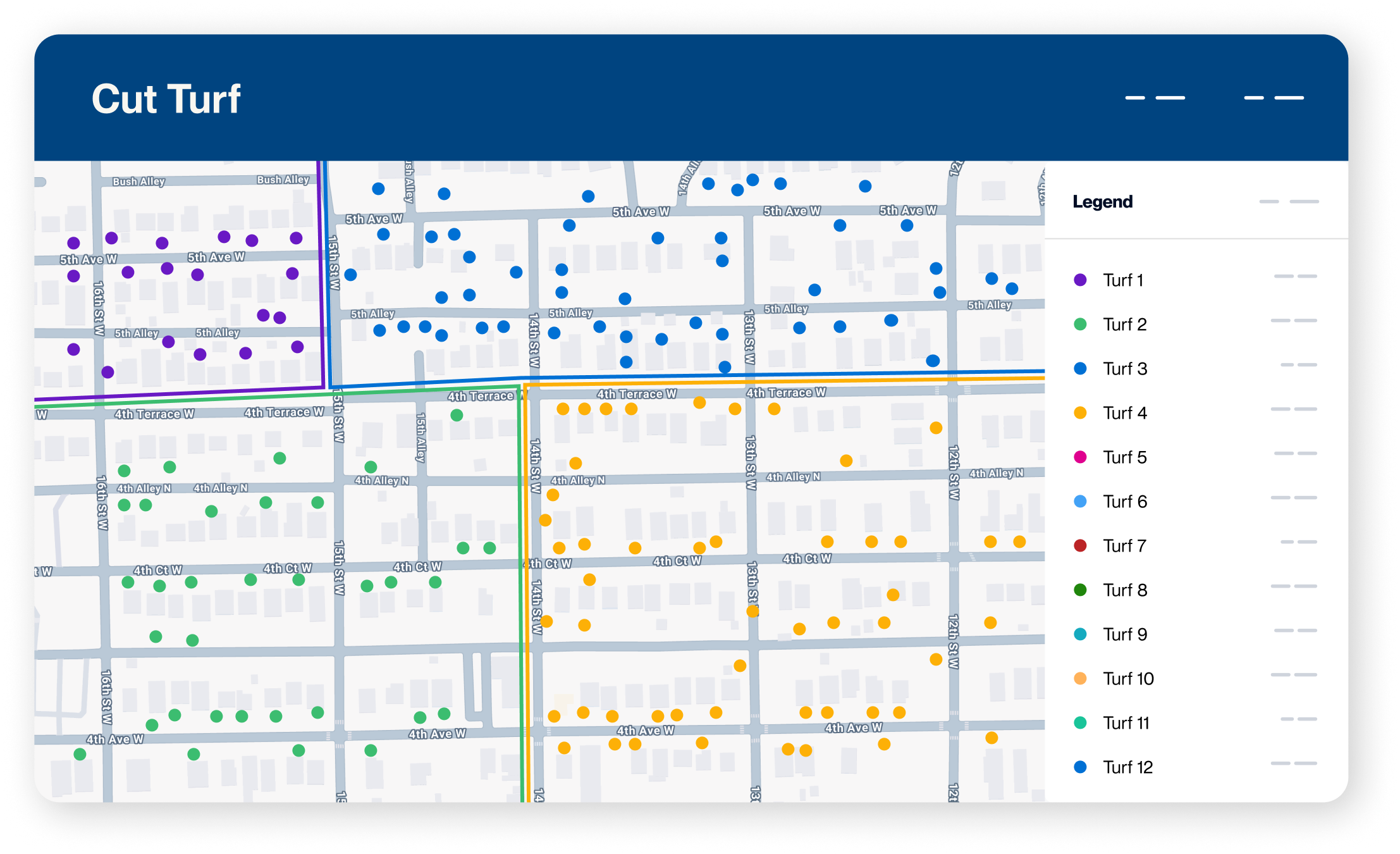
For those of you who are unfamiliar with what cutting turf is, allow me to briefly explain from the top down and the bottom up.
From the top down, in an election a campaign takes all of the registered voters in a state/district from the voter file and creates a “universe” of voters that it is trying to identify (as supporters, opponents, or undecided), then once identified are persuaded to support you, and then supporters are turned out to vote. For field, once that universe has been identified, it needs to be broken into what we call “walk packets” or “turfs” that are roughly geographically contiguous grouping of between 40 doors (if you’re driving) to 100+ doors (if you’re on foot in a dense neighborhood). A “turf” is then assigned to a volunteer who goes and knocks on every door on the packet and records the response (or non-response) information, previously on paper that had to be manually entered but now into an app on your smartphone. This data forms the backbone of our internal data about the direction of the campaign, supplemented by hard data like lists of who have already voted early, and of course polling.
From the bottom up, the entire Democratic field apparatus is built upon door knocks and the belief, grounded in actual research, that conversations on the doorstep are the most effective way to persuade and turnout voters. The entire reason organizers work to recruit volunteers for the campaign is to go knock on doors. That means that turfs or walk packets are required to tell a volunteer where to go and what doors to go knock on. Turfs are the lifeblood of a field operation.
The tale of how we cut turfs in 2024 is a microcosm for where the field needs to adapt and evolve.
In 2024, with only 35 days on the campaign, I spent roughly five days cutting turf full turf, or 14% full percent of my time in front of my computer cutting turf manually. I think I cut over 1000 turfs but honestly I don’t remember, it was absolutely north of 500 and happened in two mind numbing chucks.
Here’s part of a document that outlined our GOTV universe turf cutting in 2024:
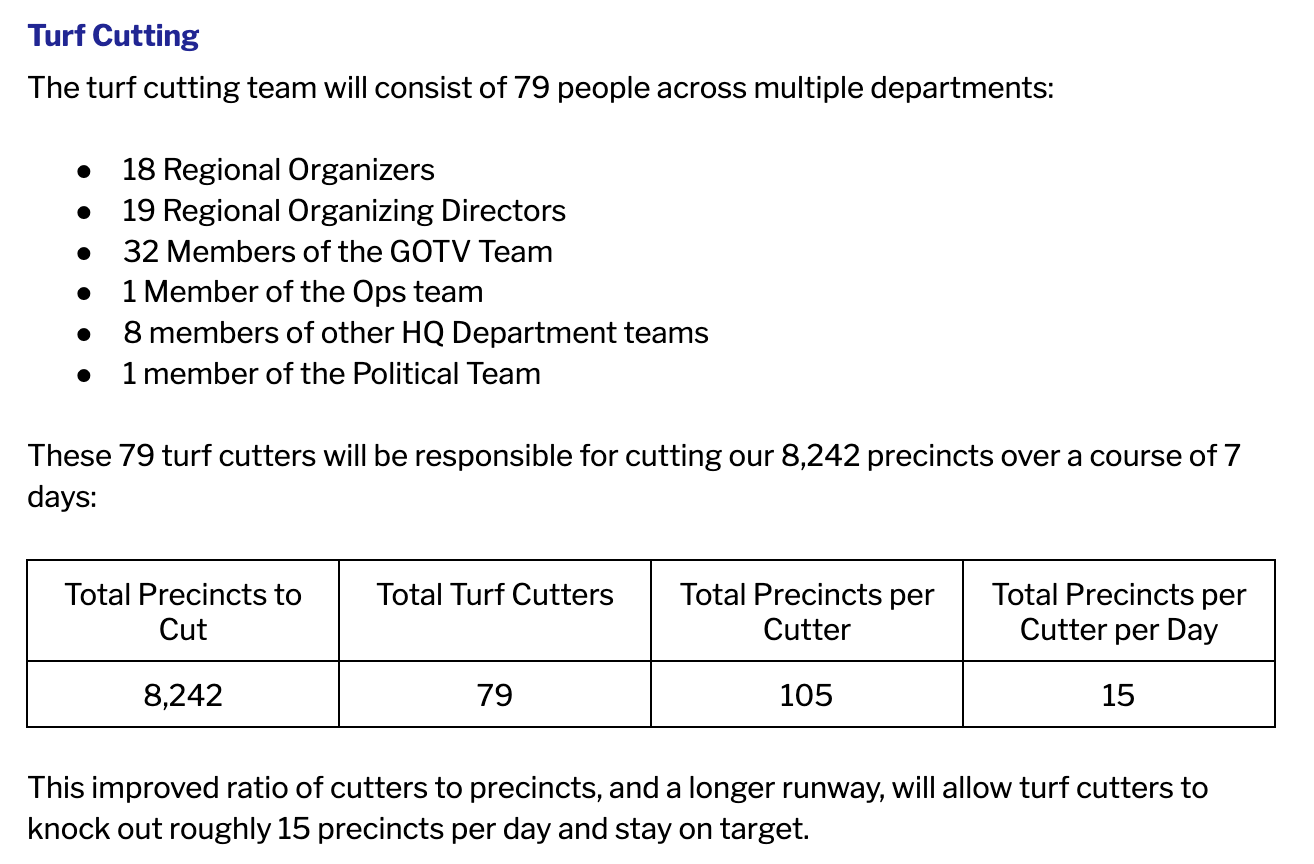
A precinct is the smallest electoral area and it is contiguous (if sometimes oddly shaped), which you then cut into multiple turfs, anywhere from 2-10 turfs, with each turf suitable for an individual to knock by themselves or in pairs.
Pennsylvania had 8,242 precincts in 2024 and in Philly those precincts are wards (big area) and divisions (smaller sub-areas). So for example, in my region of South Philly, I had two sub-regions (can’t for the life of me what we called that category) that we named Passyunk and Far South Philly, one with 102 precincts (wards/divisions) with 395 turfs/packets and the other with 138 precincts with 487 turfs/packets (wards/divisions).
Now you might ask, how do you cut a turf? Well we used to draw them by hand on paper maps with highlighters, back when this was a real art, but now we use the map tool in NGP that automatically loaded the universe were trying to reach, represented by black dots in the houses we want to hit, and then we manually click and draw lines to encompass contiguous tufts. This video is from 2022 but its the same tool we had in 2024 (and I’m confident the 2026 tool looks the same):
Now look, can you zone out, get into a flow state, and stay up late into the night cutting turf? Sure, and I did, cutting hundreds of turfs, maybe a thousand turfs. And sure my turfs were pretty good.
But why was I spending hours cutting turfs?
I believe back even in 2024 there was an auto-turf button built into the VAN. Why didn’t we use it? For reasons I am sure that we don’t trust the machines, this is not how we did it in Obama 08, we can’t afford to fuck up the turfs, etc. it was just safer to make us cut the turfs ourselves. And so we did. 80+ paid staffers cut turf
In 2024 there was talk of outsourcing it to volunteers who had experience but couldn’t be in the field, in the same way we outsourced phone banks to virtual volunteers primarily outside of swing states, but for whatever reason it didn’t work out and so we fell back on making the staff do it.
But at what cost?
I was the only GOTV staffer in South Philly, a region that helped provide Biden’s 2020 margin, and one that I desperately needed more time out organizing for GOTV. The other 78 staffers on that campaign also had other shit to do. Yes, I know we needed turfs, and that the turfs had to be good, but this smacked of something by now we should have found a better way to do.
NGP-VAN wrote “In 2024 alone, NGP VAN users spent more than 94,000 hours on the turf auto-cutter page, with the vast majority manually preparing maps and packets for canvassers, or “cutting turf.”
94,000 hours in 2024! Those turf cutting hours all added up and they mattered! Maybe not enough to win an election but imagine if they’d been used to do something else! This is the actual promise of AI in a campaign (or in a workplace generally) the machine learning and generation of rote mechanical knowledge work.
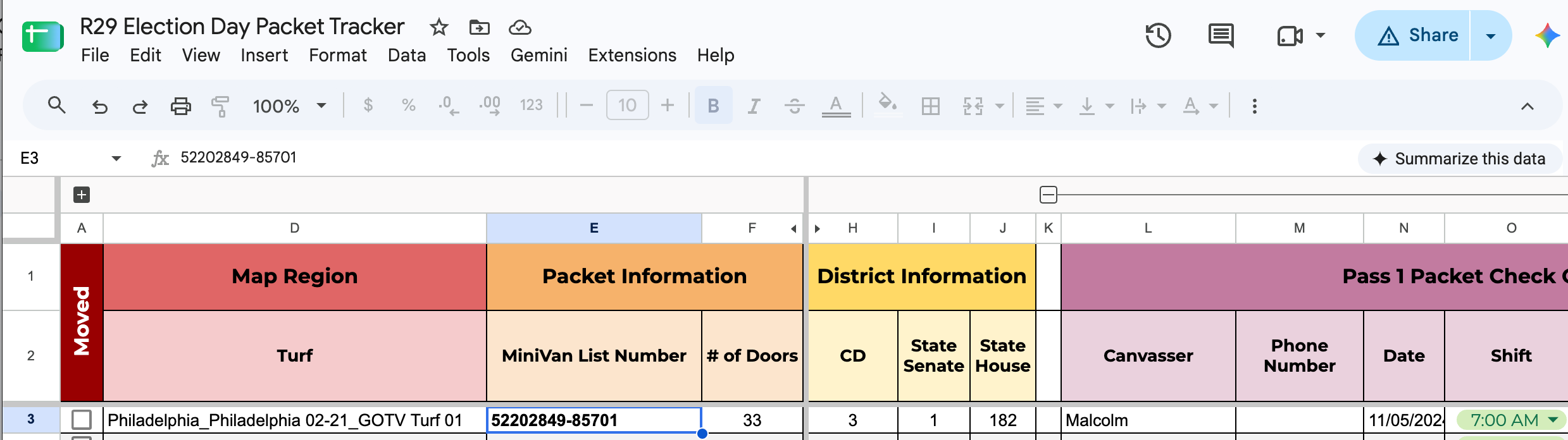
And don’t even get me started on HOW we checked out turfs to volunteers. Turfs we made in VAN, that were accessed through VAN, volunteers who signed up through mobilize and into the VAN, all were loaded…into two fucking different Google sheets that we had to manually update?!? We will have to return to the campaign overreliance on putting everything into fucking Google sheets another day.
Cutting Turf in 2026
Which brings me back to this tweet today and (after I checked) some of my email lists, and found many states and campaigns asking for help cutting turf for GOTV.
Look, I will say this to not be too mean, I am not offended by the OP that they are looking for volunteers to cut turf, and if campaigns choose to do it this way I hope that these campaigns find volunteers to do so. Distributed turf cutting (and maybe staff auditing) would’ve left me with far fewer complaints about this particular topic (I am writing a substack rant about this at 1am after Yom Kippur).

But I googled to see if NGP-VAN had a made an AI turf cutting tool yet and found this announcement from July 30, 2026:
NGP VAN, the leading technology provider for Democratic and progressive campaigns, today announced upgrades to its turf auto-cutter feature that turns what used to be hours of manual map-drawing into minutes. The improved turf auto-cutter dramatically streamlines that process, generating smarter, more intuitive routes while preserving organizers’ ability to make final adjustments.
The enhanced algorithm creates more walkable, campaign-ready turfs by accounting for real-world geographic features such as highways, rivers, railroads, and other barriers that can make canvassing inefficient. Organizers simply choose their preferred parameters, and the tool automatically generates editable canvassing maps that align more closely with how experienced field organizers would build it themselves.
Look, maybe this new turf cutter is absolutely horseshit, I mean it’s still NGP-VAN so I don’t expect it to be different when I log in later in 2026 or in 2028. But even if it’s bad, I have to ask, is it bad enough to really matter?
To a campaign that’s looking at cutting turf the old fashioned way, please try the automated tool and just pour your efforts into human auditors (we had 19 separate staffers auditing the turf the 79 of us cut in PA in 2024). And measure how bad the auto-cut turf really was and how much time your auditors spent fixing it, and figure how much time you really spent or saved that way. I think you’ll end up net positive.
Campaigns that are using automated turf cutting tools, please speak up, and tell everyone if its working and if it is not to be scared of it.
And if the auto-cut turf product is truly that bad, let me know. It should not be that hard to train an AI model on how to draw good turfs, keep in mind NGP-VAN has a digital copy of almost EVERY SINGLE TURF EVER GENERATED BY THE DEMOCRATIC PARTY AND ITS ALLIES, which is a huge data set to train a model on to do one thing, cut fucking turfs.
Look I’m not here to dog on the field hands just trying to get their shit down as it gets down to the wire this cycle or my bosses in 2024 who made me cut turf. That’s just field as we’ve always known it, I get it.
But that attitude can hold us back. I think most of us know that Democratic field would never have taken the necessary step to get fully on MINIVAN if not for COVID, we’d still be rocking paper or some sort of monstrous hybrid system.
The campaigns of the future, the ones being run now in 2026 and the ones that are going to be pioneered in the 2028 primary, I suspect much of them are going to have to be AI tool native. But field, the most resistant to technological change, deserves to benefit from efficiencies from technology too.
Look, I don’t have any good answers to the fundamental question hobbling organizing and communication generally. Every channel is saturated now, no one picks up their phones due to spam calls, text messaging fundraising ruined the channel as an organizing tool, no one opens emails anymore, and generative AI is only going to make it worse.
I don’t have an answer to that, the best I can say is that you organizers, paid staff, even volunteers should no longer spend that much time manually cutting turf.
Anyway, part of being someone who has been around for a long time, is that I have the memory about how things have always been done and the freedom to speak up and speak out on how we should fix things for the future. Also, I will inevitably go back into the field again and I will not handle it well if I’m stuck manually cutting turf.
I hope I am wrong, I hope most campaigns are using technology to cut turf. But if you’re not, read this post, take a chance on the turf auto-cutter, audit the shit out of it, and then take that time back to do organizing.
And if the auto-cut turf tool really is that bad, let me know, and I’ll either help you cut your turf manually or help us figure out how to make it better, and get you some of those 94,000 hours back.
Go, fight, win out there field staff. All you can do is all you can do, so thank you for all you do.
Previous Posts
What is GOTV? For that I pull a definition I wrote last year about my time on the ground in 2024:
What is GOTV? GOTV is the acronym for Get Out the Vote. The phrase means a few different things: As a descriptor, GOTV describes the actions a campaign takes to turn out your supporters to vote for your candidate to try and win an election. As a specific time period, GOTV is the four days before and including election day, including the final weekend. As a job, GOTV is the team responsible for preparing for and executing the final efforts to get supporters to vote in the election. Confused? Much like how fuck is the most versatile word in the english language, during a campaign GOTV is a noun, verb, and an adjective (Fuck is also a word liberally used by GOTV during GOTV for GOTV). GOTV is politics, campaigns, and elections at its most elemental. It is campaigning stripped down to its essence, GOTV is the campaigning that I live for.
I'm very rarely tempted to respond to a Substack but I'll bite on this one! First, my credentials - I've cut turf since 2012, campaign staff since 2016, participated in probably a half-dozen of these centralized turf-cutting operations as staff (running 3 of them) and a half-dozen more as a volunteer.
I will start by saying that I 100% agree that AI turf cutting is the way of the future and someone should get to work on the project of creating a better turf cutter stat. I love cutting turf, but I also hate auditing the bad turf cut by people who aren't good at it, don't want to do it, and whose time would obviously be better spent out talking to people and winning elections. I won't shed a tear when this entire process is automated and I absolutely believe the technology exists with current AI models to produce turf that is good enough, most of the time, to justify any trade-offs.
That being said, I never allowed people to use the VAN auto-cutter as a data director (except in very rare circumstances like post-election ballot cure canvassing), and none of the data directors I know who are currently on races allow it either, and I fully stand by that decision.
I was familiar with the auto-cutter as it existed through the 2024 cycle and there were two major obstacles to using it as a time-saving tool for GOTV turf cutting specifically:
1. The lines didn't touch. I know this sounds like a petty data person nitpick, but it actually created a real issue. The only reason it makes sense in the first place to cut GOTV turf six weeks before Election Day is if you can re-use the same turfs several weeks in a row, refreshing the universe so new doors populate in the turfs you've already cut. As inefficient as manually cutting turf is, you know what's more inefficient? A canvasser walking by the home of a perfectly good target in order to get to a farther-away target because the target just isn't included in a turf at all. To do this, you need every piece of the precinct allocated to exactly one turf, even if the block/street doesn't currently have any targets. That means drawing turf boundaries so the lines touch almost perfectly, with no overlap and no empty space left un-allocated. Not only did the old-school auto-cutter NOT do this, in my experience, it actually did the opposite - the lines were as close to where the current targets were as they possibly could be, with no buffer around the targets at all. That meant manually adjusting every single turf until the lines did touch - if you didn't do that, you'd be stuck re-auto-cutting every single turf, every single week. Which brings me to...
2. It didn't actually save time. The auto-cutter didn't automate the process of running the search, loading the map, hitting "cut", saving the turf to a folder, or generating the list number. It only automated the process of actually drawing the lines, leaving a lot of manual overhead that would have to be done regardless, plus the manual auditing that would be required. Additionally, the old auto-cutter famously had a bug where it would create WAY more "corners" in the shapes than a human would if they cut the same turf. That meant manually adjusting turfs was absolutely excruciating, because to move the boundaries of a turf, you have to move every single corner. If I were to auto-cut 10 packets in a precinct, and I needed to adjust the boundaries of just one of them, I think it would take me more time to do that than it would take to cut all 10 packets by hand myself. That means "let auto-cutter do a first pass and then have a human audit and fix" just isn't a workable solution.
So that's why auto-cutting wasn't the answer for 2024. Now, VAN says they have a new, "smart" auto-cutter that can cut turf that is much closer to how a field organizer would - not crossing highways, keeping streets together, etc. I haven't personally been able to confirm how well it does that, but I haven't heard any indication that they fixed the two issues above, even though any coordinated data director would tell you that those have always been the two main obstacles to making use of the auto-cutter. If they did fix those issues, that's great. Anecdotally, I heard that the roll-out of the new auto-cutter came packaged alongside a ton of user-experience bugs in the turf cutting tool more generally that make cutting turf a worse experience now, even if you choose not to use the auto-cutter, and that doesn't inspire a lot of confidence in how well they did at implementing the new feature.
I think what's so frustrating for campaign data people is that we KNOW the technology is there for a better auto-cutter, we KNOW exactly what features it needs in order to actually be workable and save time, and we're generally tech-savvy people who are down to automate and try new things if it can actually make our lives easier, but as far as I know, NGPVAN isn't interested in hearing our feedback. Fourteen years of using VAN as a volunteer, FO, ROD, and data staffer, using nearly every single feature, in multiple states and on large and small campaigns, and I can't recall a single time anyone from NGPVAN the company reached out to me to ask why I don't use the auto-cutter they're so proud of and what they could do to make it better. None of the data staff I know who are currently on campaigns have been reached out to to test or provide feedback on the new auto-cutter. It seemed like they just assumed they knew what the problems were and how to fix them and plowed ahead without actually talking to the people who would be impacted by these changes, and in the process, made an already imperfect tool noticeably worse.
The reality is that it doesn't actually matter that much how good each turf that the auto-cutter creates is. They could be pretty bad and still represent an improvement when you take into account the time savings from people not cutting turf by hand! For the auto-cutter to be usable, what matters is how easy it is for a person to review and correct the auto-cut turfs. Until that happens, maybe county party chairs and volunteers on small local races will get some use out of it, but it won't be a viable way to cut all the GOTV turf for a state-wide coordinated campaign with multiple federal races as stakeholders.
This is pretty indicative of the discourse on field and GOTV work. I am in my early 60’s and have worked on many many campaigns and knocked on many doors - in the last two local elections, I’m sure I knocked on 1,000 doors in each.
My comment is - focusing so much on the drawing of the maps ignores the fact that true valuable field work - IDing voters, following up effectively - is often not done at all by state coordinated campaigns or local campaigns or mostly by any campaigns, and talking in great detail about “cutting” is fairly irrelevant.
True legit field work should have many workers, thorough and strategic targeting and follow up, and documented data. I’m sure this happens - say, in Iowa for the POTUS primary - but I doubt very strongly that it is anywhere near the norm.
Knocking - as anyone who has done it knows - is incredibly inefficient and unproductive, because small percentages actually answer the door, and fewer still actually take a moment to be persuaded (ditto phone banks). I know it is the most effective form of persuasion, but that notion is usually theoretical and never realized due to lack of the incredible resources needed to accomplish it properly.
Whenever a candidate or the media refer to the “1000s of doors knocked,” I know that is typically false or generally inaccurate. It is just not happening the way the theory says it should.
I would like other’s perspectives on this - maybe my experiences are not representative, but I would be very surprised.