

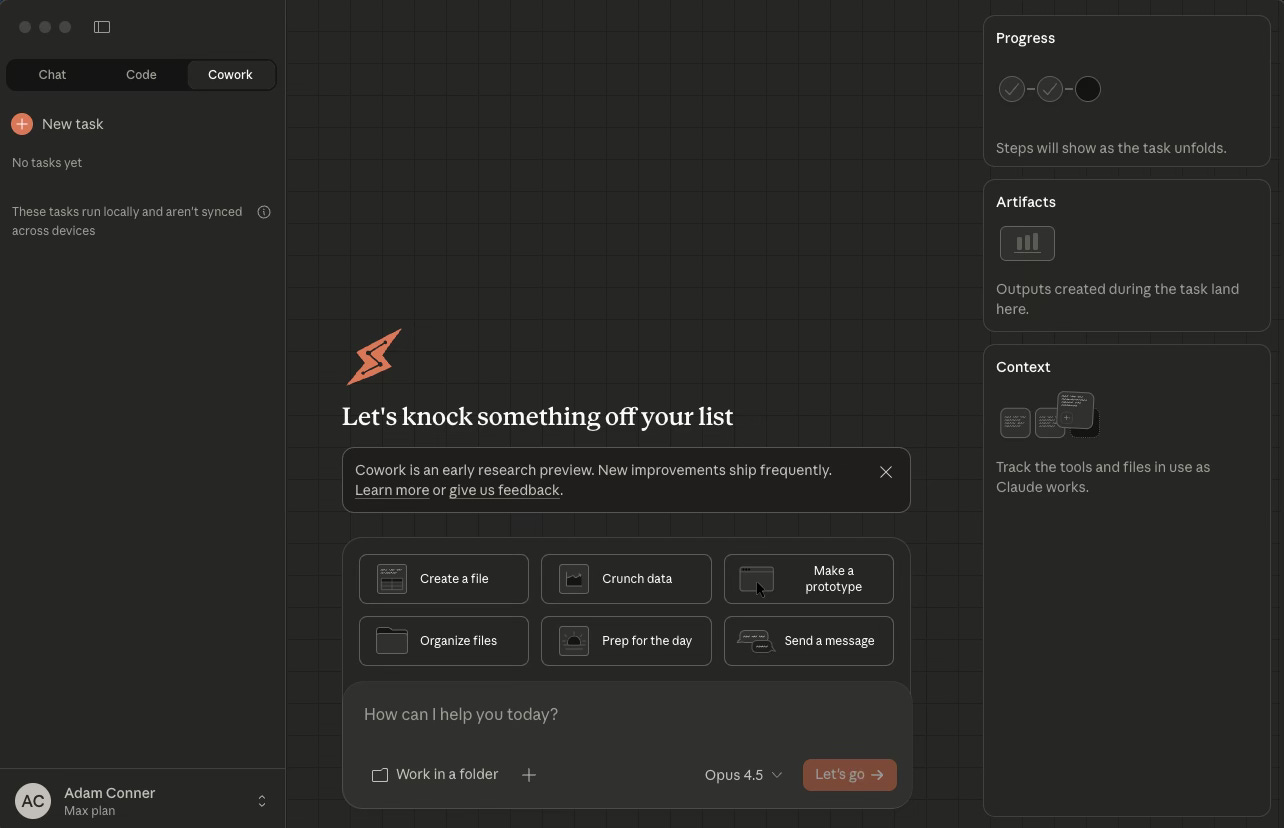
Update 1/12/26 at 4:17 PM: Today Anthropic announced Claude Cowork, essentially an interface for using the Claude Code AI agent in the desktop app without having to use the command line/terminal interface. A big step towards the end state I imagined when I wrote "there will be vaster fortunes to those who abstract this power to something simpler and easier to use.” It is available now for Max users and it’ll be interesting to see how it’s received and how quickly it rolls out more widely.
Update 1/9/26 at 12:54 PM: Since this is a pretty long post, I have added a short table of contents and links to the five sections, which I couldn’t figure out how to get the right URLs with a scheduled post last night.
You spent your holidays with your family? That’s nice I spent my holidays with Claude Code.
Everyone Remembers Their First Vibe Code - My AI Labor Market Impact Simulator
You spent your holidays with your family? That’s nice I spent my holidays with Claude Code.
“The biggest divide on AI timelines I’ve seen is between people who use vibecoding tools like Claude Code and people who don’t” tweeted David Shor right before Christmas. Something shifted over the holidays, maybe people had more time on their hands, and Claude Code didn’t exactly go mainstream but it broke through to the online masses, spawning numerous memes like this one.
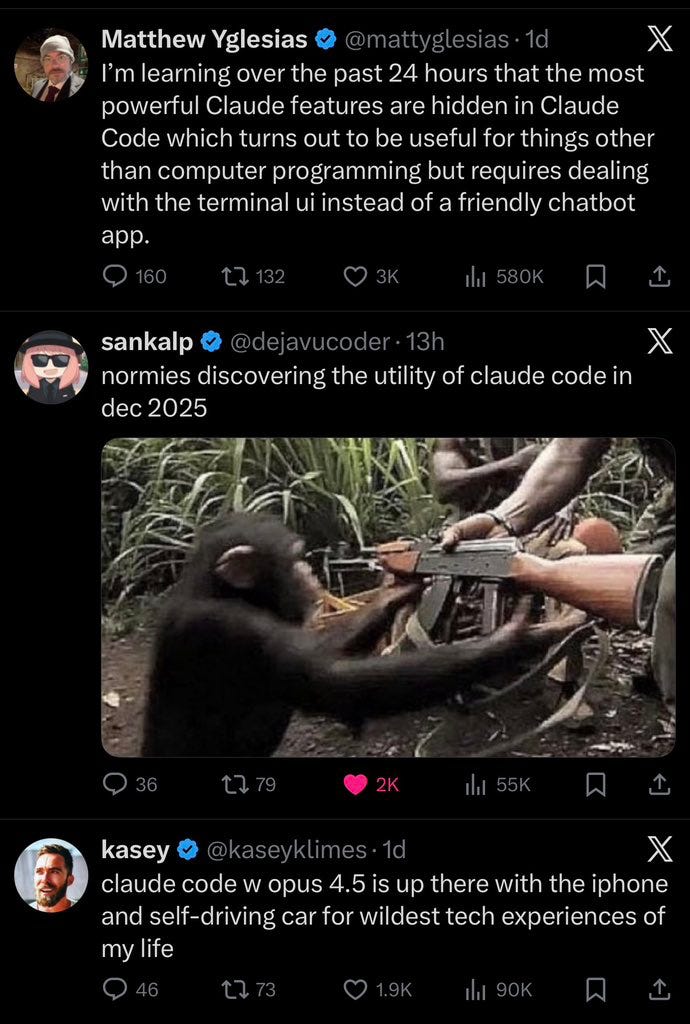
This was my experience too, though I had jumped on the Claude Code train a few weeks before the holidays (congratulates himself for being slightly on the edge of the early adopter train).
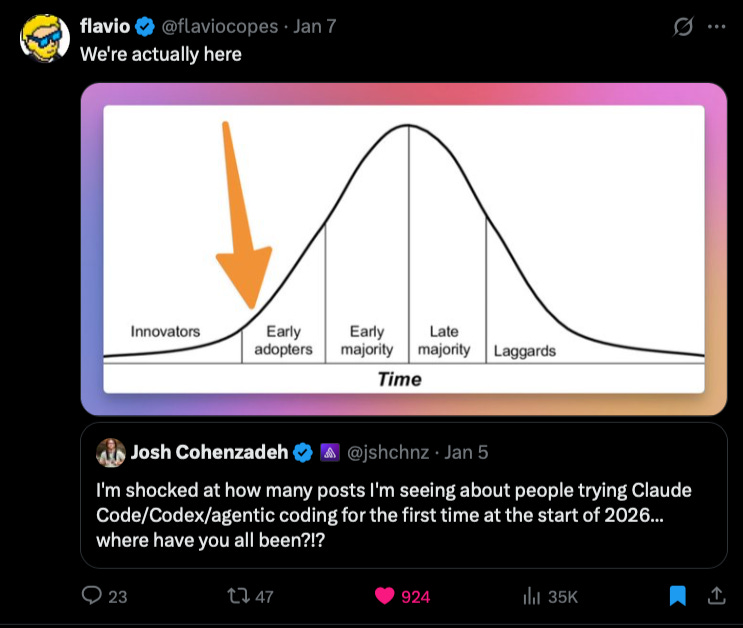
Shakeel Hashim described Claude Code well when he wrote:
The combination of an extraordinarily intelligent model (Opus 4.5), a harness that lets it work autonomously, maintain a pseudo-memory, and execute commands (Claude Code), and complete browser control (Claude in Chrome) results in something truly powerful. In a very meaningful sense, Claude Code is a knowledge worker.
How would I describe Claude Code? I am not sure if mine are technically correct but I would say that Claude Code is a way of engaging with an advanced AI model through an AI agent that can do complex multi-step tasks that you tell it to do. It can write code, create new files, access your computer’s files, and use various tools including a browser. It is a way to interact with and harness the power of AI beyond the chatbot format that is how most people engage with these frontier models. But it is done through the command line, the barest essence of human interaction with computers, and so it appears to be technical and intimidating. Yet the part we have spent the last few years training people on, talking to chatbots, works in Claude Code too. You can and should just start by engaging it in conversation, ask it to do stuff, look at what it does, and give feedback and tell it to keep going.
It is akin to having an endless stream of robotic staffers of various high and low skill and it really lays bare how good a boss you are in describing things. As Shakeel says, “Yes, it’s closer to “someone smart on their first day of work” than “an expert who’s been doing this for decades.” But I am willing to bet that it can nonetheless do significant portions of your job.”
How is the quality? Well that kind of depends on a lot of factors and what you’re outputting. Your limitation is some combination of is it something that can be digital, can it live solely in Claude Code or does it need to interface with other things on the internet, and can you describe it accurately enough and refine it before you hit your Claude limits for the day.
Since the holidays there have been a flood of posts from some really smart people writing about Claude Code for non-technical audiences including Dean Ball, Casey Newton, Ethan Mollick, Kelsey Piper, Shakeel Hashim, Matt Yglesias, and Matt Hodges. These post run the gamut of trying to explain why Claude Code is important, how non-technical people can understand it a bit more and use it, what people have been vibe coding, and what AI agents like Claude Code might mean for certain industries.
And now I add to that wave of Claude Code takes, because I am a proxy for an audience of the non-technical exploring these new tools that might take all our jobs and destroy the world, the policymakers trying to make sense of this new world while those living in the future already live in wonder and fear, and someone who was on the ground floor of the last technological revolution.
I have spent the last month vibe coding, building teams of agents to create my own ideologically diverse policy council, building a personalized writing editor, and in so doing have made Claude Code a central and essential part of my daily digital life, both work and personal.
In playing around with Claude Code, I can see the power of the future of AI in a way that breaks out of the chatbot format and it has a lot to tell us about the future. Claude Code has taught me something about the future of work, the inevitable displacement of jobs, and how the digital future increasingly integrates with our physical world but still remains distinct…for now.
Adam sets up Claude Code and you can too
I should note up top that you need a paid Claude account (starting at $20 a month) to access Claude Code. I think it’s worth $20 to check it out and I dunno you can help make the number’s in Anthropic’s decks look bigger as they raise their next round (just kidding the investors aren’t bothering to look at decks they’re just throwing money at them).
A few weeks ago, when Anthropic updated their Claude Mac Desktop app to have a desktop based version of Claude Code, it was the impetus I needed to take the plunge to figure it out (there is also a web version of Claude Code).
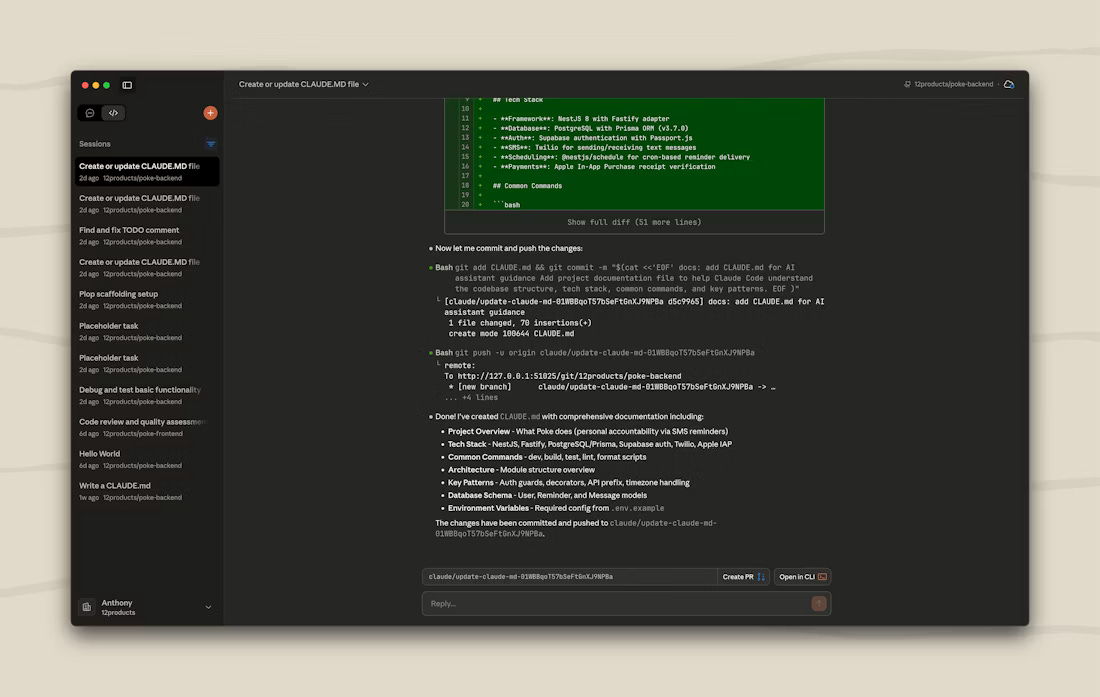
While I had a decent understanding of AI frontier models and the chatbot format, to be honest, I’ve had trouble integrating and maximizing chatbot based AI into my work and personal usage flow. But I understood that the chatbot format was just one interface to interact with the power of AI and it had been on my to-do list for a while to really figure out Claude Code, and AI agents, and do some vibe coding, especially after reading Lenny Rachitsky’s blog post “Everyone should be using Claude Code more.” And I have a few good friends, both of whom are not solely code/technical, spend a lot of time in Claude Code and were telling me they were getting a lot of value out of it.
I had played around with installing Claude Code through terminal on my personal computer a few months ago but didn’t go that far beyond that because I work on a few different computers, including primarily on work laptop during the work week that I do not have full permissions on, and at home I have a personal Mac Mini M41 and a Macbook Air.
Setting up Claude Code wasn’t hard but I understand why it’s a barrier for normies to set up. It presumes you have full permissions for your computer to install programs in terminal or install an app downloaded from the internet (many people do not on their work computers). Luckily if you can install a downloaded app, Anthropic announced earlier this week that Claude Code for desktop can now save files locally, increasing the ease of setup!
As I mentioned I use a couple different computers, including a work one I don’t have full permissions on, so I did the extra work of setting it up with an online repository for ease of access across devices. Luckily, I have had a little used GitHub account for a long time and it wasn’t that hard to set up. I am not a coder but having started my career at Facebook in the early days, even on the non-technical side, meant I have a pretty baked in understanding of repositories, branches, pull requests, merges, etc. It is certainly simpler to just use it on your personal computer hard drive though that limits your ability to use it on your phone or other computer.
I can see when Anthropic makes Claude Code a little easier to set up (already making progress), and probably abstract that setup a little more by hosting stuff for the user, it’ll open the Claude Code up to even more to the masses. But I can also see why they haven’t done that yet because then you’re also basically adding a full on cloud file hosting service too, which has plenty of downsides, mostly that it is pretty boring and annoying relative to the cutting edge.
Once you’ve got Claude Code setup, whether in the terminal, desktop, mobile, or web app, the interface is the same, a terminal interface. I am sure this can be a little intimidating to some but we’ve also been training people to interact with AI through a chatbot interface for the last few years, so treating it like a chatbot is a perfectly fine starting point if you’re not technical. Just start asking it questions or asking it to do stuff (the Lenny Rachitsky post has some good examples).2
The main thing I can say is that if you’re not as experienced in terminal or technical specifics like repositories, you can just repeatedly ask Claude Code to explain stuff to you, and specifically give you step-by-step instructions for stuff it says you need to do or want to do.3
Everyone Remembers Their First Vibe Code - My AI Labor Market Impact Simulator
I started off with Claude Code by doing some vibe coding.
I have been working with my colleagues to start to try and think about the potential impact of AI on jobs and the resulting various economic scenarios we could find ourselves in. But there were so many potential variables that it was kind of hard to imagine them all and hold them in your head.
So the first thing I decided to do was try and vibe code a simulator of the impact of AI on labor and the economy. I wanted to be able to set sliders for things like unemployment levels and AI adoption rates and visualize the impact on jobs created or productivity level.
In the span of a night it managed to code a pretty simple linear simulator where honestly the main challenge was figuring out how to make it publicly accessible online for others to see (the answer was Github Pages). All I did was give it specs, iterated via chat, tested it, and filed bug reports, then tested the fixes.
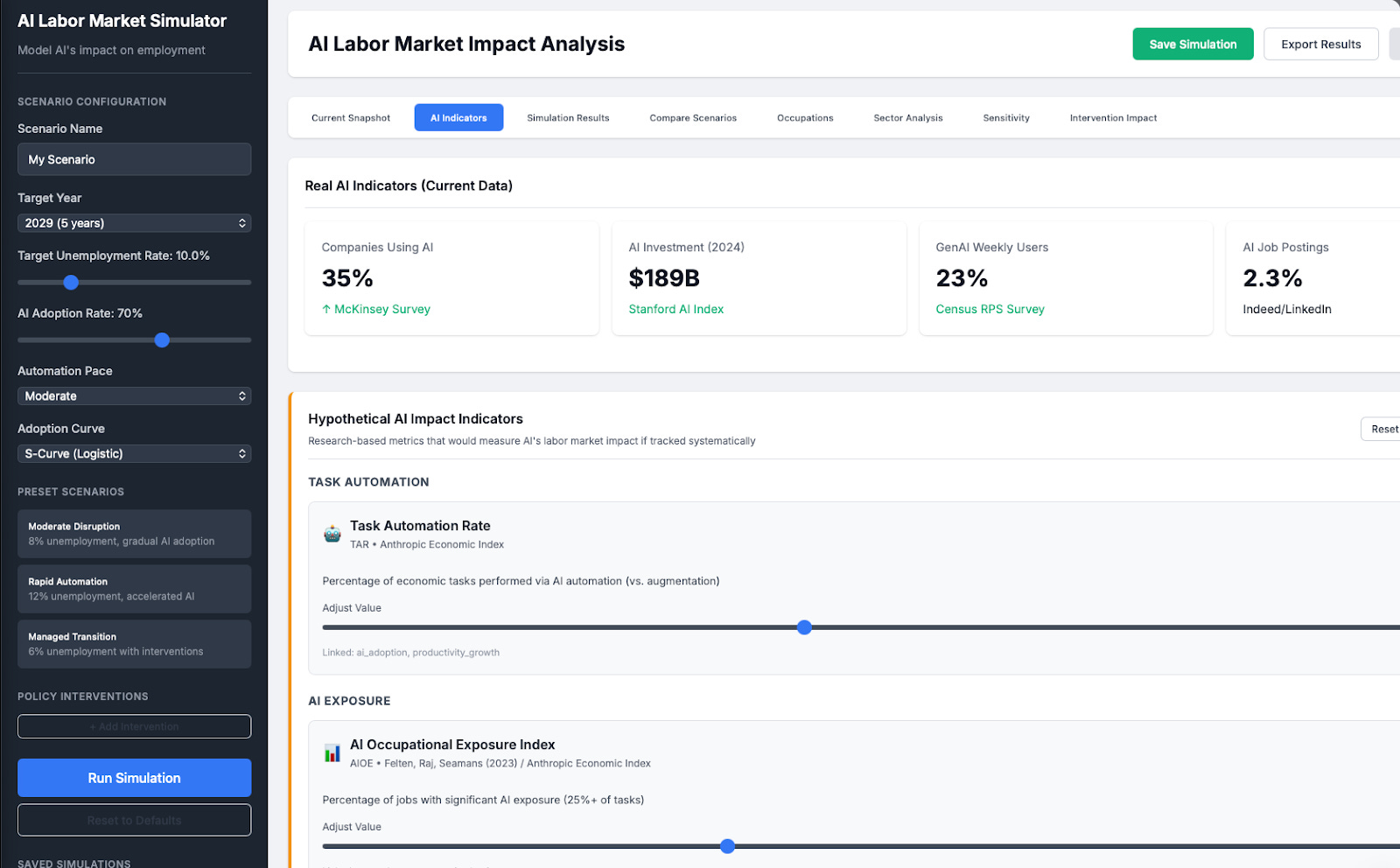
The simulator as an MVP was a nice proof of concept and started off pretty simple and linearly. But once I created it, I realized I wanted to explore what else was possible, and so I asked Claude Code “What else could we do to build and improve this AI economic impact simulator?” It came back with a whole list of improvements, from making a more sophisticated model, to adding potential intervention impacts, to increasing the visuals. I was hooked on vibe coding and started to work on the next phase.
From there we got more creative, I integrated real economic data from the BLS and Federal Reserve, signed up for a Google AI Studio trial and integrated Gemini APIs to simulate more scenarios and generate AI summaries, and more.
The second night I worked on this I quickly hit my Claude Code limits on my Pro plan and did not hesitate to immediately upgrade to the Max plan.
By this point I was more comfortable with Claude Code, so I was using it in the terminal too, in fact I was using multiple terminal windows.
When I would hit my Claude Code limits, I downloaded Google’s new coding tool Antigravity which if you have a $20 a month Pro account provides free access to Claude Opus 4.5 through its interface in a classic Google play of subsidizing initial usage, so when I would hit my Claude Code usage limits, I could just pick back up with the same Claude Opus 4.5 model in Antigravity (I have read its not quite the same but I am not sophisticated enough to tell).
I was spending a lot of time troubleshooting bugs but when the agents could access the browser, Claude Code in Chrome and Google Antigravity being able to use Chrome too, allowed for a level of testing in the browser to find bugs that decreased my time on that once I figured that out.


In the end I had a AI Labor Market Impact Analysis Simulator that used AI to simulate stuff, Machine Learning to do other stuff, various sliders to set different levels of unemployment and AI adoption, and toggles for various interventions like UBI or job retraining.
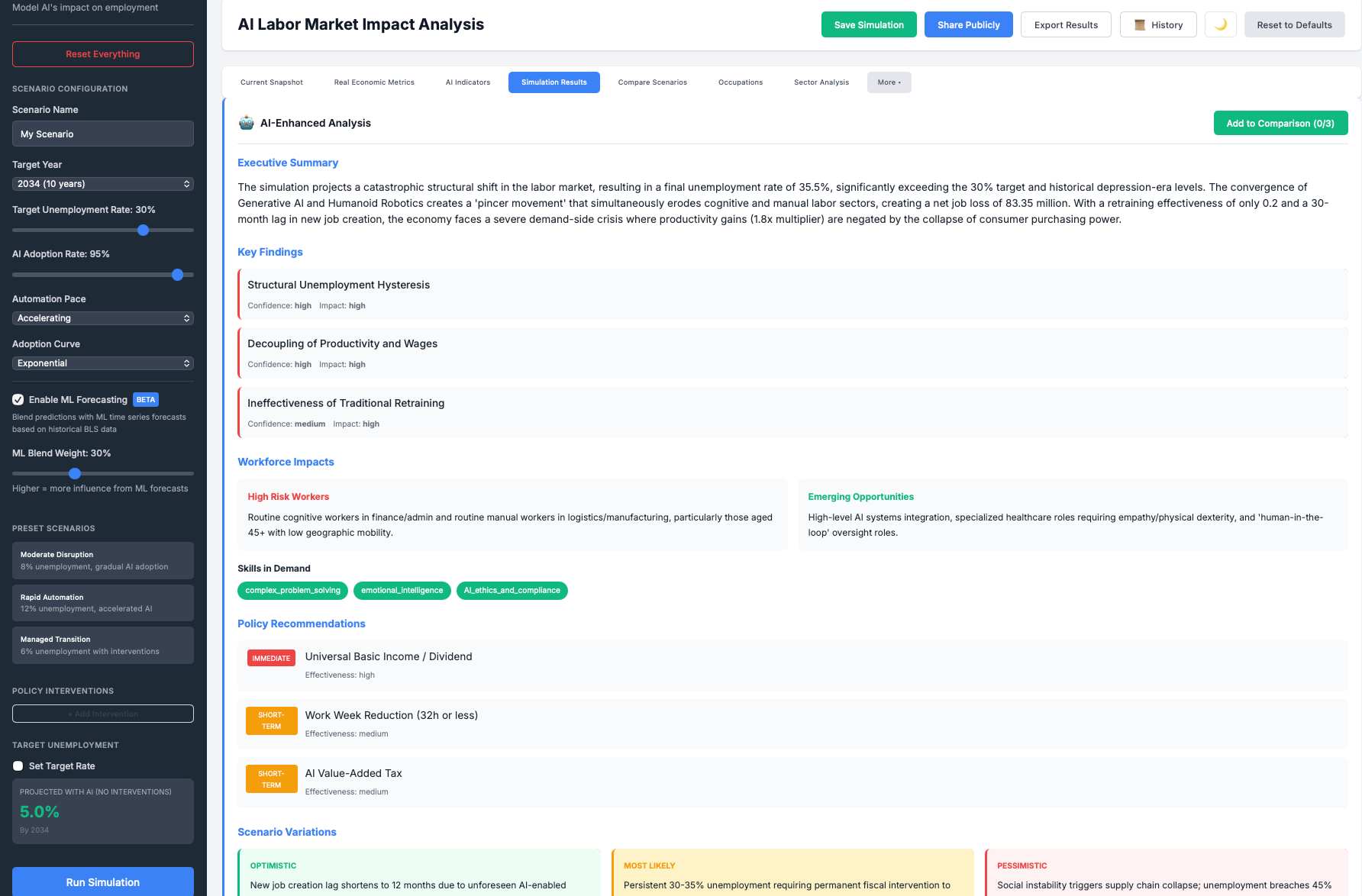
And you can access the projects if you want to play around with it!
https://adamconner.github.io/adamconner-claude-laborsimulator/
If anyone is interested in the code, you can see it here on GitHub. I messed around with and abandoned an SDK version others could take and install and tweak but never finished it, but feel free to play around with it.
Building my own policy council
I’ve never had the privilege to work in the White House (leaving me an outlier at my job and in my own home) so the only way I will ever get to run a policy council is by building my own agentic AI version.
I wanted to try creating what I called a Policy Council, loosely based on the idea of the Policy Councils like the National Security Council (NSC), the National Economic Council (NEC), and the Domestic Policy Council (DPC) that run normal White Houses (this White House relies mostly on the last person he talked to and makes Marco Rubio do everything).
One thing I wanted to play around with was the use of multiple AI agents to do different tasks, or the same tasks with different perspectives but the same instructions. The other thing I tested and understood is that Claude can create text files (markdown or word) which allows an output that is not solely code based.
In particular, I was interested in playing around with creating multiple AI agents with various skills and ideological perspectives so I could try and have them come up with various policy ideas.
So I had Claude Code create multiple AI Agent Policy Analysts with the following ideologies:
Policy Analysts (14)
Economic Populist — Working-class economic impact, anti-monopoly
Progressive — Progressive reform, social equity
Centrist — Bipartisan solutions, stability
Conservative/Market — Market principles, limited government
MAGA Conservative — America First, traditional values, sovereignty
AI Safety — Risk mitigation, alignment, safeguards
AI Accelerationist — Technology advancement, rapid development
Capital & Industry — Investment climate, industry growth
Rights & Consumer Protection — Civil rights, consumer protections
Organized Labor — Worker protections, job security
Environmental/Climate — Sustainability, climate action
Small Business — Main Street, entrepreneurship, SMB impact
National Security — Defense, military, homeland security
International Relations — Global affairs, diplomacy, international cooperation
And then some AI Specialists:
Specialists (7)
Legislative Counsel — Bill drafting, amendment language, constitutional analysis
Legal Counsel — Constitutional and regulatory law
SCOTUS Analyst — Supreme Court jurisprudence, legal challenges
Verification & Sources — Fact checking, verification, citations
Polling Expert — Public opinion analysis
Budget Expert — Fiscal analysis, CBO-style scoring
Implementation Expert — Operational feasibility, agency capacity
Support Roles (6)
Council Director — Facilitation and process management
Writer/Editor — Document preparation and consistency
Research Librarian — Source gathering and verification
Communications Lead — Public-facing materials
Political Strategist — Political landscape analysis
Designer — Visual elements and formatting
Once I had those 21 agents created, what did I do with them? I developed a five-phase workflow to create policy proposals, with human checkpoints between each phase. You start with a topic, and 21 AI agents — each with distinct ideological perspectives — debate it from every angle, ultimately producing comprehensive policy papers with draft legislation and rollout-ready materials.
Phase 1: Idea Generation — All 21 agents propose policies from their unique perspectives, generating 60-100+ ideas in parallel, each required to include transformational “Big Ideas.”
Phase 2: Voting — Agents vote on top proposals with reasoning, revealing where consensus exists and where ideological fault lines emerge.
Phase 3: Refinement — Specialists produce research briefs, economic analysis, implementation plans, and political assessments for the winning policy.
Phase 4: Full Development — The policy expands into a comprehensive 24-section paper with draft federal and state legislation.
Phase 5: Rollout — Communication materials are created: press releases, op-eds, fact sheets, talking points, social media content, and FAQs.
I eventually built out an entire system of policy idea generation, then made the human decision to narrow down on certain topics, and then write a full suite of research papers, policy proposals, draft legislation, press releases, talking points, video scripts, and more.
My robot army of policy analysts was very good at generating a LOT of policy ideas, literally hundreds, when commanded to do so and decent at creating what I called “Big Ideas” for consideration. Especially after I integrated Google AI APIs so I could call on their latest Gemini Models to compare, contrast, and generate different ideas than Claude Opus 4.5.
My theory that getting various ideologies to vote on ideas and come to agreement was less successful, inevitably the ones that various ideologies could agree on were pretty small ball, though the generation and consideration of those policy ideas from across the ideological spectrum was a good and helpful exercise.
I would then select some for further research and refinement in shorter papers and then really long policy proposals with draft legislative text. We are talking hundreds of pages of material on the topic in a couple of hours (those hours less on the generation, which was shorter, and more me setting up and refining in real-time).
I have some examples here you can look at that I had the policy council generate for the example topic of “Increasing affordable housing availability in major US cities.”
You can see the full 30 ideas generated on the topic and an example of one of the multi-page policy ideas.
Now here are the sample outputs for Phase 3: Policy Refinement.
The top policy (National Zoning Reform) was developed into a full recommendation with supporting analysis.
File - Description
- national_zoning_reform_recommendation.md - Main policy recommendation
- research_brief.md - Academic literature and evidence
- economic_analysis.md - Cost-benefit analysis
- implementation_plan.md - Phased implementation roadmap
- political_assessment.md - Political viability analysis
- one_pager.md - Executive summary (1 page)
- talking_points.md - Key messages for advocates
Key Findings
- Feasibility: Medium (legal authority strong, implementation complex)
- Political Viability: Moderate (65-70% Dem support, 35-45% GOP support)
- Economic Impact: High ($20B+ annual savings, 600:1 benefit-cost)
- Recommended Vehicle: Infrastructure reauthorization bill (2026)
But it didn’t stop there. Phase 4 created a 24 page proposal paper and 12-page draft legislation. Then Phase 5 created rollout materials including an executive summary, a press release, an oped, a fact sheet, talking points, a social media toolkit, and an FAQ.
All this took about 20 minutes to generate 15,000 words worth of example materials which is kind of a holy shit moment.
So the obvious question, were the policy outputs good?
I want to be clear, this is not a policy position I support, or maybe I do, I haven’t even read these documents. I just generated it as an example to share here. I was not an expert on the topics that I asked my policy council to work on, so the answer is that I am not sure. But I think it very clearly looks close enough to being serious that alone may change the equation on how we work on these topics. And I think that goes to our next topic, which is how it impacts the future of work.
But you don’t have to take my word for it. I have made a version of the Policy Council that I built available on Github so you can launch your own version in Claude Code:
https://github.com/adamconner/claude-policycouncil-template
Just check out the readme for instructions on how to get started:
https://github.com/adamconner/claude-policycouncil-template/blob/main/README.md
And check out all the example documents here:
https://github.com/adamconner/claude-policycouncil-template/tree/main/examples/affordable-housing
Claude Code and the future
When you use Claude Code and have some success with it you can start to see parts of the future. The things that can exist in the digital form can be analyzed in record amounts of time. The content that we generate, words first and now pictures, sounds, and videos, are increasingly only digital artifacts and can now also be generated faster than ever. And the ties that bind our digital world to the physical world, the websites that book travel or make restaurant reservations, will be even further integrated into these machines that aim to ease their use but at a cost we don’t yet fully understand.
You don’t need a fancy vibe coded AI impact on labor markets simulator to realize that it is not just hype, that AI is obviously going to impact how jobs and work happen. Just working on these projects for fun over the last month has shown me that.
Something I vibe coded generated a policy position and 15,000 words in policy papers and supporting materials outputted in 20 minutes. But policy papers are not what turns ideas into action. First, there’s the expertise needed to see if these proposals are bullshit or how to turn a starting point into something real. There’s the judgement needed in how to approach these topics to avoid policy issues and political landmines. And there’s still a human to human element in convincing policymakers that ideas are not only good but viable and beneficial. All that is to say that I don’t particularly fear for my job at this moment in time, as a think tank person whose job it is to come up with ideas, refine and package them, and then (hopefully) sell them.
But it is abundantly clear to me that the way we have traditionally development that expertise and judgement in knowledge work, by doing smaller parts of the work, by reading and researching and writing, by working your way up the ladder, by learning from those more experienced, is maybe in the greatest danger in the AI era.
Companies are going to hire fewer junior staffers, it is the most obvious and inevitable response to this new technology (and maybe the data shows that), because these AI models can probably do entry level tasks at a level close enough to a college graduate, and the gaps are made up by the lower costs. But they, but we, are probably seeding the path to our own destruction in the future because it is less clear how that expertise is going to develop in the next generation if they’re never given the chance to develop it. Maybe that experience and learning can be imparted via AI but even if it can, I kind of doubt we’re going to see companies hire a generation of middle level knowledge staff who never worked on something at the lower level, and that expertise and judgement in certain fields is going to be a commodity that starts to die out. Maybe I am being too pessimistic and alarmist but Idiocracy didn’t happen overnight either.
Anthropic co-founder Jack Clark had a post before Christmas, “Silent Sirens, Flashing For Us All,” that described the world he sees coming soon, as in this year (emphasis his):
This problem will worsen in 2026. By the summer I expect that many people who work with frontier AI systems will feel as though they live in a parallel world to people who don’t. And I expect this will be more than just a feeling - similar to how the crypto economy moved oddly fast relative to the rest of the digital economy, I think we can expect the emerging “AI economy” to move very fast relative to everything else. And in the same way the crypto economy also evolved a lot - protocols! Tokens! Tradable tokens! Etc - we should expect the same kind of rapid evolution in the AI economy. But a crucial difference is that the AI economy already touches a lot more of our ‘regular’ economic reality than the crypto economy.
So by summer of 2026 it will be as though the digital world is going through some kind of fast evolution, with some parts of it emitting a huge amount of heat and light and moving with counter-intuitive speed relative to everything else. Great fortunes will be won and lost here, and the powerful engines of our silicon creation will be put to work, further accelerating this economy and further changing things.
And yet it will all feel somewhat ghostly, even to practitioners that work at its center. There will be signatures of it in our physical reality - datacenters, supply chain issues for compute and power, the funky AI billboards of San Francisco, offices for startups with bizarre names - but the vast amount of its true activity will be occurring both in the digital world, and in the new spaces being built and configured by AI systems for trading with one another - agents, websites meant only for consumption by other AI systems, great and mostly invisible seas of tokens being used for thinking and exchanging information between the silicon minds. Though we exist in four dimensions, it is almost as though AI exists in five, and we will be only able to see a ‘slice’ of it as it passes through our reality, like the eponymous ‘excession’ from Iain M Banks’ book.
Claude Code itself doesn’t change the world overnight. It’s too stuck in a command line that too few will unlock in its current format, though there will be vaster fortunes to those who abstract this power to something simpler and easier to use (I say vaster because there are already unbelievably vast fortunes already being made in the AI age). But Claude Code is a window into what the AI future may be. It’s not a crystal ball but a glimpse of the future today. And we should all be playing around with it to try and understand that future.
I have always been of two minds on what the AI revolution will look like.
One part of me worked at Slack and sold enterprise software you had to pay for to large customers, primarily the US government, and saw how fucking hard it is to get large organizations to change. So yes, AI diffusion will be slower and more painful than we think.
The other part of me was on the ground floor of the last technological revolution as an early Facebook employee. I remember walking around the halls of Capitol Hill trying to convince people that social media wasn’t a fad but a new tool that would change everything. It’s funny, once you’re convinced you’ve seen the future part of you tries to evangelize to others. But another part of you, another part of me, used to think about the inevitability and power of certain tipping point technologies. At a certain point you didn’t bother trying to convince people to use fire. You either used fire or you died.
This is not me saying that Claude Code is like fire, one of the fundamental discoveries and tools that changed the course of human existence. But Claude Code may be like the first spark man made which eventually caught fire.
As an aside the Mac Mini M4 is truly an insane computer for $500 and everyone should buy one if they have a WFH setup and hook it up to a KVM switch.
Here are some things I read, watched, or listened to that helped me understand Claude Code better.
Teresa Torres: Claude Code: What It Is, How It’s Different, and Why Non-Technical People Should Use It
Peter Yang, Behind the Craft podcast, interview with Teresa Torres, “Full Tutorial: Build Your Personal OS with Claude Code in 50 Min”
Armin Ronacher, “What Actually Is Claude Code’s Plan Mode?”
Anthropic Academy, “Claude Code in Action” course (I haven’t done this just looks like an extensive resource)
One FYI - Claude Code for Desktop on the Mac doesn’t allow you to turn on Planning Mode right now, which is very powerful and is accessed by the keystroke Shift + Tab in Terminal, and which is just moves to the next interface box in the Mac Desktop App due to the universal Mac controls in those kinds of apps.