

There has been a lot of chatter recently about how 2028 presidential campaigns should be thinking about integrating and using AI as they start to stand up. AI use in campaign 2028 is a separate question of AI policy, which is what I do in my day job and will clearly be a central driving issue in the 2028 presidential campaign, but let me just say that I am writing everything here in my personal capacity.
Addisu Demissie was killing time this weekend and kicked off a discussion about AI and 2028 campaigns.


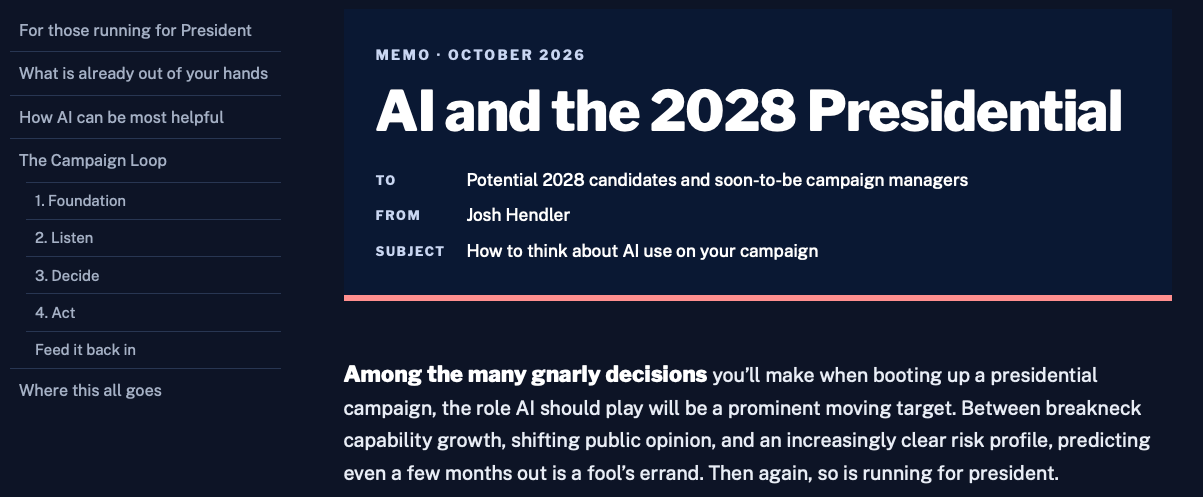
My good friend Josh Hendler, a former CTO of the DNC among other things, put up this piece recently entitled “AI and the 2028 Presidential” that everyone should take a moment to read.
My other good friend Kate Gage from Higher Ground Institute the “AI Campaign Stack” site which is a series of helpful resources for campaigns and AI.
So with that a few thoughts to contribute to the AI and campaign 2028 discourse. First, am I even qualified to comment on this? Probably not. I have never run a national political campaign or been in presidential HQ at a high-level (I was an intern in a literal closet). I have also never been a full-time field organizer (FO as they used to be called). I am a low-level (well medium-level I guess) field guy, a GOTV specialist who drops in at the end of the cycle for election mobilization and then heads home.
But I have had a front row seat at the cutting-edge of online organizing. I was part of the OG blogosphere (MyDD in the house), was there as online organizing took off, the first employee in DC for Facebook and Slack, creator of the “I Voted” button at Facebook, partner to Democratic campaigns as they built on Facebook and Slack, and I am also terminally online (follow me X the everything app).
Maybe most importantly, and maybe rarely, I am a natural organizer both online and offline. That is not to say I know everything, far from it, but I do have some thoughts on the future of organizing, which I will write more about in the future but you should all read the 2025 report on “The Future of Democratic Organizing” from Greta Carnes and check out what Yasmin Radjy from Swing Left wrote the other day.
Every election there is a rush from reporters to write stories about how this is the (insert hot new technology election) and press staff eager for the headline. And thus I have lived through (and been quoted in) numerous stories about how this election is the internet/text message/Facebook/Twitter/YouTube/Snapchat/Meerkat/TikTok election. Now everyone wants to write about how this is the AI election and how 2028 campaigns should be using AI. To be clear, I think you should go and ask some of the 2026 campaigns for their ground truth on how they used AI.
A few thoughts on AI and 2028 campaigns.
1. Presidential campaigns are actually several different campaigns stacked on top of each other in a trenchcoat
A presidential campaign may look from the outside like a single operation but is really several mini-campaigns operating under one roof. In the early days of a presidential campaign each of these jobs may be done by a single individual or one person may be juggling several of them. I would think of a presidential campaign’s core responsibilities as the list below:
Basic candidate logistics: Most (but not all) presidential candidates actually have a day job (Senator, Governor, etc.) and so a presidential campaign is often sharing the candidate another office, set of responsibilities (where they sometimes do not control their calendar), and even legal restrictions (what they can do during session, coordination between offices, etc.). Remember, the most precious commodity a campaign has is the candidate’s time and how they maximize using it when they do have it, which is true even if the candidate doesn’t have an existing other job.
Basic campaign organization: This is the campaign manager and the basic structure of the organization as it is stood up. This is the candidate logistics above, IT, payroll, legal, hiring, etc. I think sometimes people underrate the first point, that presidential candidates often have other jobs, and so the campaign manager is theoretically the one with the full time job of caring about the campaign. That doesn’t mean they’re necessarily driving the strategic direction of the campaign, a senior advisor(s) may be actually running the strategic direction of the campaign, especially if they have a long personal history with the candidate, but someone needs to lay the tracks and making the trains run on time.
Fundraising: Money is the lifeblood of campaigns, both in practicality (people need to get paid) and in terms of viability (candidates need to raise money to be taken seriously). This includes raising money offline (call time and donor events) and online (email fundraising, etc.) Even in the era of Super PACs and tighter coordination where some things can be coordinated or offloaded, you’ll still need some hard money to survive and show you’re a serious campaign. Now can AI help you run a leaner campaign requiring you to raise less or stretch a dollar farther? TBD.
Digital/Content: This is honestly the lifeblood of a campaign in 2026 and in 2028 when mastering the attention economy will be essential to gaining any sort of traction. I have previously written that everything is just short form video now (as Matt Yglesias says “The internet is a small miracle that in practice we mostly use to watch short-form video”) and social networks are now mostly algorithmic distribution platforms for short-form video now. This very good interview with the Talarico campaign’s Antonio Esparza who was their creative director and speechwriter gives some good insights into how a modern candidate and campaign needs to craft and distribute the kind of daily content that is essentially the modern campaign. This content feeds into press/comms, paid media, fundraising, and ultimately real viability.
Press/Comms: It is my own act of rebellion and digital supremacy that I put digital/content above press/comms here. But through the invisible primary electorate has evolved beyond the Gang of 500 and now encompasses blue checkmarks, influences, and more, it is still one that is also bound in the traditional outlets as validators and essential gatekeepers of the traditional national and local media (they are just not the only gatekeepers anymore).
Policy: A small policy team (often with many volunteers) designed to 1) guide policy development and response from key principles and the existing record, 2) come up and flesh out the tentpole or signature proposals and policy responses as required, 3) setup the bare minimum national policy platform needed to have a viable campaign. You can debate if policy is downstream from comms or comms is downstream from policy but they’re a mutually dependent and self-reinforcing (or self-weakening) cycle. But also everyone thinks policy is some big portion of presidential campaign staff and it just isn’t. As Rob Flaherty tweeted the other day, “Policy is downstream from message.”


National and early state organizing: This is simultaneously the most and least like a statewide campaign. You can and should organize in the early states like it’s a traditional statewide campaign, put organizers on the ground, and give them space and time to actually organize (if only because everyone will be). But Presidential campaigns are different from any statewide campaign because they really draw a national audience of supporters who are not necessarily localized to any of the early states. And you need to harness that energy from across the country and try and figure out how to direct it into viability and also fundraising. Technology tools are often the thing that are experimented with here from Howard Dean 2004 meetups to and Barack Obama’s 2008 my.barackobama.com.
These are not hard and fast definitions and obviously campaigns are so much more than than that but understanding these various jobs can help you understand how AI might play a role in these parts of the campaign and now they might help a campaign work together.
2. The campaign manager AND the candidate
Josh writes in “AI and the 2028 Presidential” that “If you only take away a single piece of advice from this memo: hire a campaign manager curious about AI who actually uses it.” I think this is right, you want a campaign manager who is using tools like Claude or Codex early on if only because it means that 1) they might have a chance of scaling and handling the information and decision flow that will only swell, 2) they will have some ability to think about how to craft the work/reports/metrics in a way that might be automatable by AI, 3) they will have some sense of what it mights to apply this tools outside the box in a new way.
But beyond the campaign manager, I do think there’s an interesting question about how much the candidate should be aware of and using AI tools regularly. You don’t need a candidate who uses it every second of every day but it is an interesting question about how a candidate using AI regularly would benefit from it as a candidate. Running for President is a profoundly isolating experience and makes you incredibly staff reliant. There’s ways, good and bad, that a candidate who is fluent in AI tools and has access to their own campaign infrastructure could keep abreast of their own campaign operations like never before (which might not be good for the campaign or the campaign manager).
3. What does it mean to “use AI” in the presidential campaign?
The reason I listed all the different sub-campaigns of a presidential campaign is because it helps us to better understand what using AI in a campaign means.
How would a presidential campaign benefit from the most advanced frontier AI models? I am hard pressed to think where a presidential campaign would benefit from setting dozens of autonomous agent swarms for hours on end. Those agents are not going to come up with the perfect verifiable campaign policy platform or magically organize every voter in an early state.
Instead using AI will fall into the same categories that AI is being used by every enterprise organization as it diffuses:
It will be used to automate rote or routine work
The number one use of AI is doing stuff like copying and pasting stuff from one tool to another, say from VAN to a Google Sheet, which you can do now with browser use. There are plenty of other examples, daily clips, social media monitoring, daily reports. Or my favorite example from this fall, cutting turf which should absolutely be automated. I am not sure this will automate these jobs entirely away but in theory this should free up staffers to focus on the more important parts of their jobs (this does not always happen).AI will be used to do more stuff at scale that it was hard or impossible to do before
The scale and ease of AI means now you can do stuff at scale that wasn’t possible before. Maybe research can now troll all of the property sale records or ethics reports. Maybe it’s possible to generate even more custom advertisement copy and finer targeting and upload it to an online ads platform. I’m not sure but this is the other place where you CAN do more things though the metrics should still determine if you SHOULD do them.AI will be used to do new original things
This is the giant question mark and this is for the practitioners to go out and innovate on the campaign trail in the future.
One of the things I realized during my time back on the 2026 campaign trail is that the metrics that I was responsible for reporting were not particularly easy to compile, they required a lot of manual digging in VAN (or fucking VANs plural) or Google Sheets or both. The metrics, where all holdover metrics from the Obama 08 years, were not in any way adapted to the reality that they should be automated so that organizers have to spend less time putting them together and that was pretty achievable. I spent hours having my Codex use browser control to pull my reporting metrics from votebuilder and turf trackers but it was a good reminder that we can build our metrics and our tools to make life far more seamless.
4. The AI-native campaign
The phrase that is all the rage in tech now is the “AI-native startup.” In the AI age any new startup in the age of AI is structuring itself differently, operating more leanly, and using AI to fill the gaps that people would have traditionally taken. It is a tale as old as technology transformation that is always easier to start with a new technology as opposed to transforming an existing enterprise. But the good news is that no presidential campaign really exists right now, these are all going to be new startups formed in the coming weeks and months, and all of them have the chance to build themselves as AI-native campaigns and take full advantage of the new technology to build the most competitive campaign possible.
5. How you start matters
Josh’s “AI and the 2028 Presidential” has a ton of actionable advice.
Pick Claude or Codex and set up enterprise accounts.
You’re going to use Google Suite but I do think there’s a question about how to make it work with their Advanced Protection Program which most campaigns are or should be using which limits access to the email to third-party apps like Claude or Codex (it is why I can’t use either with my email). Google’s AI products are not there yet for what you want to use them for though the built-in Gemini stuff is getting better.
Setup Slack which I think has some really interesting potential with Claude. Check out these videos about Claude Tag and how Anthropic uses Claude in Slack:
Before the 2016 hacks and everyone forcing too much onto Signal, Slack was the one new tool that thrived in campaigns because that communications method made a lot of sense for campaigns. You can see how something like Claude Tag could really be the way that campaigns interact and utilize AI in a seamless way. Imagine on a small level something like an approval chain, which usually has to be manually shepherded in a slack channel and a google doc, being automatically done now in a channel with Claude Tag.
Also I will just say we need to stop putting everything into a fucking 24-hour auto-deleting signal messages the Russians don’t care about the approval chain.
6. Database of Record
I actually think that Josh’s recommendation about a “Database of Record” is actually a pretty gnarly question. He writes, “Invest in a robust, modern database of record that agents can query through MCP” and “Everything the campaign learns feeds the database of record and knowledge base, so each day’s listening starts with more than the last.”
Makes total sense. But what is the database of record and how do you set it up for a campaign?
Your data sources in a campaign live in a variety different places:
Voter file - VAN
Campaign finance and donors - NGP or something else
Donations - ActBlue or something else
Volunteer management - Votebuilder?
Events - Mobilize
And that’s before you get to social media content, advertisements, email, etc.
I’ve been out of the digital and campaign game too long to say I have any idea how to best set this up.
I do think it is a good analogy to understand how the commercial sector has come to use Salesforce as a database of record. Unfortunately, and I say this as a Salesforce hater, Salesforce has become even more important in the AI and AI agent age because unlike humans AI agents always will out Salesforce and keep your database of record up-to-date (for now it will be very funny if models advance to a point of intelligence where they took end up hating filling out Salesforce).
I am not saying that Salesforce is the right answer for campaigns (I am not sure I would say Salesforce is ever the right answer) but getting the database of record right is a key initial setup challenge for the campaign one that: automatically syncs in the data from other sources, secures it, backs it up, and provides version and access control so no one can accidentally vibe code over it. Setting it up correctly and allowing access though Slack and MCP will let folks access and vibe code on it without harming it.
Maybe Josh can write a follow-up on how to actually setup a database of record.
6. What are some ideas for how AI can be used on a presidential campaign?
Here are some ideas for how AI could all be initially setup:
RAG for ALL your content
RAG stands for Retrieval-Augmented Generation which is basically an AI LLM that only pulls from the sources you give it, so it doesn’t hallucinate. The main commercial product is Google Notebook though there are different ways to build it into products using Google’s APIs.
Every campaign should be automating from Day 1 EVERYTHING that the campaign puts out, press releases, social media content, website updates, anything and everything so that anyone at the campaign can query and get information on what the campaign has said and where. Setup auto transcripts for all your videos with timestamps and file locations and feed them in as well. This is both to help the campaign with its own avalanche of materials and also to be able to do self-oppo on yourself.RAG for all your OPPONENT’s content
Similar to above, you should be automating pulling in and archiving everything that your opponent posts, says, or does into a database that you can query when you need to uh draw contrasts.Automate your reports
I come from the field mafia where reports in a google form are the lifeblood of the campaign (should they be? Definitely not but whatever) but there are plenty of parts of a campaign (fundraising, organizing, etc.) that are metric driven and submit regular reports. As much as possible automate these reports and pipe them into both Slack and your database of record for the future.Create plugins and skills for your systems
Once you have determined what regular tasks your campaign is using AI for, for example to generate automatic reports or auto-generate a briefing, consider creating standard plugins or skills so that these are done universally the same across the enterprise. Build feedback learning into it so that the models can learn from this.Build to auto-generating briefings
Every campaign writes endless briefings for the candidate. Make sure that you are saving every briefing and training AI agents on this and eventually you should be able to automate part of these briefings.
If this sounds skeletal, it is because the AI integrations for an AI-native 2028 campaign should be built and vibe-coded by those who are on them doing the work. I can’t wait to see what they come up with.
Tune in next time for my thoughts on the importance in field of building a better two-way VAN and Google Docs integration (tl;dr we are overreliant on google docs in field entirely because of people like me who come in late and have to run part of a campaign from with a random gmail address so we need to be able to easily grant access to documents which is a CISO nightmare).
I disagree in a sense that "AI use in campaign 2028 is a separate question of AI policy..." The way a campaign is run is ALSO downstream of message, like 2016 Sanders refusing a Super PAC.
On the Dem side, I expect at least one candidate to circulate or sign a "No AI Pledge" for their campaign/consultants, either as part of an environmental policy message (more likely) or a Break Up Big Tech policy message, or even the P(doom) message (#YangGang?).
There's maybe also room in Dem Top 10 for one candidate who does the opposite and does big public displays of their AI-usage that intentionally provokes, but this would also be tied to a pro-technology set of policies.
I know you meant the above quote to make clear this is written in your personal capacity, which is fair.